
What Is a Business Appraisal? Business Appraisal vs. Business Valuation Explained

If you have been asked to obtain a business appraisal, you may wonder what the request means. Does it call for a report prepared by a certified appraiser? Is it different from a business valuation? Will an estimate used for planning satisfy a lender, attorney, or tax advisor?
In everyday use, business appraisal and business valuation often refer to the same underlying activity: analyzing a business to estimate its value. The words alone do not tell you how much work will be performed, what report you will receive, or whether the result is suitable for a particular purpose.
Those details matter. A business owner exploring a future sale may need a different report from an owner involved in a disputed buyout or preparing a gift or estate tax filing.
This guide explains what a business appraisal involves, how the terminology is used, and the questions to ask before ordering a report.
What Is a Business Appraisal?
A business appraisal is an analysis of a business or ownership interest that results in an estimate or conclusion of value as of a specified date.
The analysis may consider the company’s financial performance, expected future earnings, market transaction evidence, assets, liabilities, and risks. The appraiser also needs to know why the value is being determined and what, precisely, is being valued.
For example, these are different assignments:
- Estimating the value of an entire operating company before a possible sale
- Valuing a 25% ownership interest for a partner transaction
- Valuing a company for gift or estate tax reporting
- Valuing a business interest involved in divorce or litigation
The company may be the same, but the relevant ownership rights, assumptions, applicable requirements, and report scope may differ.
A useful appraisal states its purpose, valuation date, subject interest, and key assumptions clearly enough for its intended readers to understand the conclusion.
Is a Business Appraisal the Same as a Business Valuation?
The terms are commonly used interchangeably. An owner might say “business appraisal, ”while a professional uses “business valuation” to describe the analysis and report.
Neither word, by itself, guarantees a particular level of work or credential. A request for a “valuation” could mean an early planning estimate or a certified report. Likewise, someone asking for an “appraisal” might need only a preliminary indication or might need a report for a legal or tax matter.
The practical distinction is what the engagement requires:
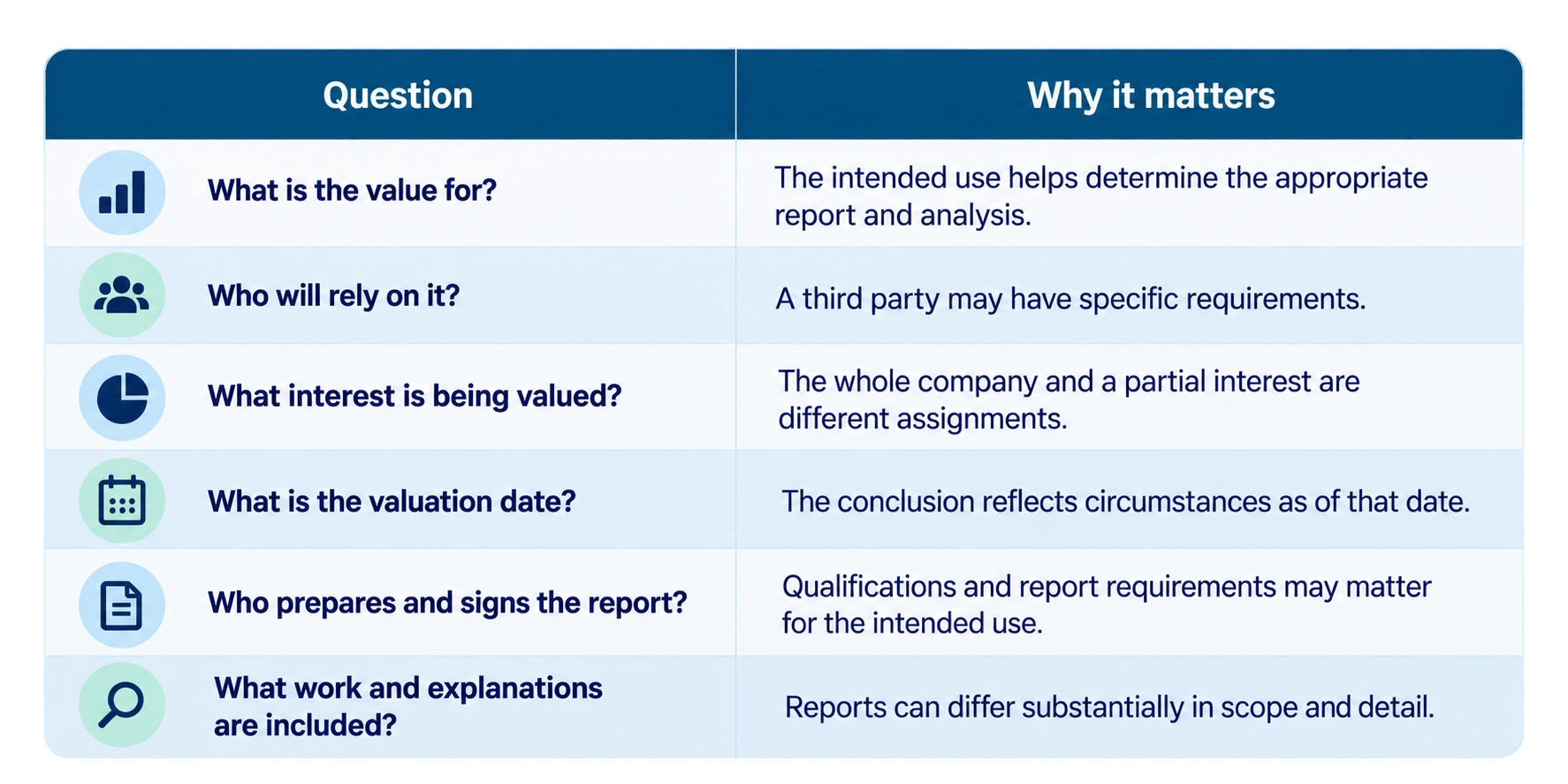
Instead of relying on the label “appraisal” or “valuation,” describe the decision the report needs to support.
When Would Someone Need a Business Appraisal?
Owners and advisors seek appraisals for many reasons. Common examples include preparing for a sale, considering a purchase, setting expectations for a partner buyout, or planning succession.
A lender, attorney, or tax advisor may also request a valuation for a specific transaction or filing. In those cases, it is helpful to establish the requesting party’s requirements before work begins. A lender-ordered appraisal, for example, may follow a different ordering process from an owner’s planning report.
The reason for obtaining a value affects what information matters most. An owner considering a sale may focus on transferable earnings and what buyers could acquire. A disputed ownership matter may require close attention to agreements, the interest being valued, and the relevant legal instructions.
One report should not automatically be reused for every later purpose. Its date, assumptions, scope, and intended use may no longer fit the new question.
What Does a Business Appraiser Examine?
Financial statements or business tax returns usually form the starting point. They show historical revenue, expenses, earnings, assets, and liabilities.
The appraiser reviews trends and asks whether the reported results reasonably represent the company’s expected performance. The analysis may consider:
- Changes in revenue and margins
- Owner compensation and duties
- Proposed financial adjustments
- The sustainability of earnings
- Known changes in the business
- Relevant market transaction data
- Assets and liabilities
- Risks that could affect future financial benefits
Owners and management provide context for material changes and identify transactions they want considered as adjustments. The appraiser evaluates how that information affects value.
A business appraisal is not automatically a financial statement audit, legal review, property inspection, or test of management’s projections. Separate specialists or services may be needed when those questions are important to the decision.
Why Are Financial Adjustments Part of the Analysis?
Reported earnings can differ from the earnings a business is reasonably expected to generate.
A company might pay a personal expense on behalf of an owner, charge above-market rent toa related party, or record an unusual gain. Conversely, an owner might work in the company without receiving reasonable compensation, or the company might defer necessary spending.
Financial normalization evaluates whether such items should be adjusted to reflect ongoing operations.
Adjustments can increase or decrease earnings. They require explanation and support; an expense is not removable simply because it occurred in only one year. The appraiser must also avoid removing a cost while assuming the business retains the revenue or benefit that cost produced.
This work matters because many valuation methods rely on earnings. If the earnings measure is overstated or understated, applying a sophisticated formula will not fix the underlying problem.
What Methods Are Used in a Business Appraisal?
Business valuation methods are grouped into three broad approaches.
Income Approach
The income approach estimates value from the financial benefits the business is expected to produce. Depending on the circumstances, the appraiser may use a representative ongoing benefit or a forecast that reflects expected changes over time.
The analysis must consider the risk of receiving those benefits and use a rate consistent with the financial measure being valued.
Market Approach
The market approach considers prices paid for other businesses or ownership interests. An appraiser may calculate the relationship between transaction prices and financial measures such as seller’s discretionary earnings (SDE), EBITDA, or revenue.
The transaction evidence must be interpreted. Businesses differ, and private sale databases may provide incomplete detail about what was included in a price. An SDE multiple, for instance, should be applied to consistently calculated SDE rather than EBITDA.
Asset Approach
The asset approach considers the company’s assets and liabilities. Recorded book values may need adjustment because accounting amounts do not necessarily represent economic value.
This approach may be especially informative for a company whose value is closely tied to its assets. An established operating business may also have earning capacity that is not captured by subtracting recorded liabilities from recorded assets.
The appraiser considers which approaches are relevant and explains the methods relied upon. Using all three does not mean giving each equal weight or averaging their results.
For a fuller explanation, see “Business Valuation Methods: The Income, Market, and Asset Approaches Explained”.
What Is the Difference Between a Business Appraisal and an Equipment Appraisal?
A business appraisal estimates the value of a company or ownership interest. It considers the economic benefits of the operating business, which may include the use of its equipment.
An equipment appraisal focuses on specified machinery, vehicles, furniture, or other physical assets. It answers a different question.
A plumbing company, for example, may own vans and tools. Valuing the company based on its earnings generally reflects the operating assets needed to produce those earnings. The vans should not automatically be added again to the earnings-based business value. A separate equipment appraisal may still be needed if someone requires a supported value for the vehicles themselves.
The same distinction applies to real estate. The value of a building is not automatically the value of the operating business located inside it. If the owner will retain the property, the business appraisal should treat the real estate and related rent consistently.
What Does a “Certified Business Appraisal” Mean?
People often use “certified appraisal” to express that they need a valuation prepared and signed by an appropriately credentialed professional, with a report suited to a formal purpose.
The exact requirement should be confirmed with the party requesting the report. A lender, attorney, court, or tax advisor may need specific information, qualifications, or a particular report scope. The phrase “certified” on its own does not resolve those requirements.
BizWorth offers professionally prepared certified valuations as well as informational valuation reports for appropriate planning purposes. The report should be selected based on its intended use, not simply on whether the owner wants a longer or shorter document.
An informational report can be useful for understanding a business’s potential value. It should not automatically be substituted for a certified valuation in litigation, a disputed ownership matter, or a gift or estate tax filing.
What About Online Business Appraisal Calculators?
Many online calculators ask for a few financial figures and generate an estimate using preset assumptions or multiples. They often serve as lead magnets.
Their limited questions usually do not gather enough information for a proper appraisal. In particular, they may fail to uncover the financial adjustments needed to understand ongoing earnings. They may not ask about owner duties and compensation, related-party rent, non-operating items, or costs that will be necessary after a sale.
A calculator may also miss changes in the business that affect future results. The output can start a planning conversation, but its reliability depends on the information collected and the assumptions used.
A professionally prepared business appraisal involves interpreting the financial information and the company’s circumstances, not merely entering a few numbers into a formula.
Does a Business Appraisal Tell You the Selling Price?
An appraisal provides an estimate or conclusion of value under defined assumptions and as of a specific date. A negotiated selling price may differ.
The buyer may plan to operate the company differently or see benefits specific to their own business. Due diligence may reveal new information. Financing availability and market demand can affect offers.
The sale agreement also defines what the buyer receives. Cash, debt, receivables, inventory, working capital, real estate, and other assets or liabilities may be included or excluded under different terms.
Finally, the owner’s net proceeds may differ from both the appraised value and the agreed price. Debt payoff, taxes, transaction expenses, seller financing, and contingent payments all matter.
An appraisal gives the owner a reasoned basis for evaluating a transaction; it is not a promise about a future sale.
Does the Appraisal Value the Whole Business or One Owner’s Interest?
That must be specified at the beginning of the engagement.
The value of a company as a whole is not automatically the value of a partial interest multiplied by its ownership percentage. The rights attached to the interest, governing agreements, purpose of the valuation, and applicable standard of value may require further analysis.
Consider a business valued as a whole for an owner’s sale planning. Later, one partner wants to sell a minority interest under an operating agreement. The prior whole-company report may provide useful background, but it does not necessarily answer the partner’s question.
The same care applies when multiple entities are involved. An operating company may ownsome assets while a separate entity owns its real estate. The appraisal should identify which entity or interests are included.
What Information Should an Owner Prepare?
The appraiser’s information needs depend on the company and purpose. A useful starting point typically includes:
- Historical business tax returns or financial statements
- Recent interim financial results
- A description of what the company does
- Ownership information
- Owner compensation and duties
- Explanations of material changes in revenue or earnings
- Proposed financial adjustments and supporting detail
- Significant debt and asset information
- Known changes expected to affect future performance
The appraiser may request additional information to resolve a particular issue. BizWorth does not collect a complete general ledger as a standard requirement, although relevant ledger detail can support a proposed adjustment.
Good preparation helps the appraiser understand the business and helps the owner understand what drives the result.
How Do You Choose the Right Report?
Start with the purpose and the intended reader. Ask:
- What decision or requirement will the report support?
- Who will recieve or rely on it?
- Is the whole business or a particular ownership interest being valued?
- Is a specific valuation date required?
- Has the requesting party stated credential or report requirements
An owner exploring a future sale may need an informational valuation for planning. A transaction involving litigation, gift or estate tax reporting, or a disputed partial interest may require a certified valuation with additional analysis.
If a bank will rely on the appraisal, confirm its process before ordering; some lending valuations must be ordered by the lender.
Selecting the report first and clarifying its use later can result in a document that does not answer the required question.
Frequently Asked Questions
What is asmall business appraisal?
A small business appraisal estimates the value of a small company or ownership interest as of a specified date. It evaluates financial performance, expected benefits, market evidence, assets, liabilities, and relevant risk within the scope of the engagement.
Is “business appraisal vs business valuation” a meaningful distinction?
The terms are often used interchangeably. The meaningful distinctions are the purpose, scope, preparer, report, and interest being valued.
Can my accountant prepare the financial information?
Yes. An accountant can help assemble statements, explain accounting treatment, and identify transactions for consideration. The appraiser evaluates how that information affects value and selects the valuation methods.
Is book value the same as appraised business value?
Usually not. Book value reflects accounting balances. An operating business may have earning capacity and intangible value beyond its recorded net assets, while recorded asset amounts may differ from current economic values.
Does an appraisal always use a multiple?
No. A market method may use multiples from relevant transactions. Income methods consider expected future benefits, while asset methods examine assets and liabilities. The appropriate methods depend on the assignment.
Will every report work for a legal or tax purpose?
No. Confirm the intended user’s requirements and obtain a report suited to the matter. A planning-oriented estimate should not automatically be used for litigation, a disputed buyout, or gift and estate tax reporting.
Bringing It All Together
Business appraisal and business valuation commonly describe the same general process: estimating what a business or ownership interest is worth. Neither label, by itself, tells you whether a particular report meets your needs.
A useful appraisal defines the valuation date, purpose, and interest; examines the company’s financial performance and relevant risks; and applies methods appropriate to the available evidence. The appropriate scope depends on who will use the result and what decision it must support.
At BizWorth, we offer informational valuations for suitable planning needs and professionally prepared certified valuations when the purpose calls for a higher level of analysis. Clarifying your intended use at the outset helps ensure you receive a report that answers the right valuation question.
