
What Is Financial Normalization in a Business Valuation?

A company’s financial statements show what it reported. A business valuation also needs to consider what the company can reasonably earn going forward.
The two figures may differ. An owner might pay a personal expense through the business, receive compensation above or below a reasonable amount, or lease property to the company at a rent that does not reflect market terms. A particular year may include an unusual gain or cost.
Financial normalization is the process of evaluating whether items like these should be adjusted to better reflect the business’s ongoing economic performance. The result is often called normalized earnings or adjusted earnings.
Normalization does not mean increasing profit wherever possible. Some appropriate adjustments reduce earnings. Each proposed change needs a reason, supporting information ,and consistent treatment within the valuation.
This guide explains how normalization works, which adjustments may be considered, and why the distinction between reported and normalized earnings matters to business value.
Why Do Reported Earnings Need Review?
Tax returns and financial statements are essential sources of information. They record the company’s historical activity, but that activity may not precisely represent its expected future operations.
Suppose a company reports pretax income of $200,000. That figure may include a gain from selling an asset the company does not regularly sell. It might also include an expense paid for the owner’s personal benefit. At the same time, the company may have paid the owner less than a reasonable amount for full-time management.
Each item raises a different question. Was the gain part of normal operations? Would anew owner incur the personal expense? What would it cost to perform the owner’s work?
A valuation professional evaluates the answers before relying on the $200,000 as a measure of ongoing earnings. The purpose is to develop financial information that fits the valuation method and the company’s expected performance.
What Are Normalization Adjustments?
Normalization adjustments are changes made for valuation analysis to reported income or expenses. They do not necessarily change the company’s tax return, accounting records, or cash balance.
Potential adjustments include:
- Owner compensation above or below a reasonable amount
- Personal expenses paid by the company
- Related-party rent above or below market
- Non-operating income and expenses
- Gains or losses that are not part of expected operations
- Costs associated with a geniunely nonrecurring event
- Necessary costs that were deferred or omitted
An item’s label does not determine its treatment. “Owner expense” does not automatically mean an add-back, and “one-time expense” does not prove that a similar cost will never recur.
The appraiser considers what happened, whether it relates to normal operations, and what is expected after the valuation date.
How Is Owner Compensation Normalized?
Owner compensation requires particular care because owners may work in their businesses while also receiving the economic return from ownership.
For an EBITDA analysis, the company generally needs to retain an expense for work required to operate it. If the owner is paid more than a reasonable amount for those duties, the excess may be considered as an adjustment that increases normalized EBITDA. If the owner is paid less than a reasonable amount, or works without pay, an adjustment may decrease earnings.
For example, assume an owner receives $250,000 annually and the duties performed would reasonably cost $200,000. Subject to support for those amounts, the $50,000 difference may increase normalized EBITDA. Adding back the full $250,000 would overlook the ongoing cost of management.
The analysis should consider the owner’s actual duties, time commitment, and the work that must continue. A title alone does not establish reasonable compensation.
How Is Compensation Treated in SDE?
Seller’s discretionary earnings, or SDE, has a different definition. At its most basic level:
SDE = EBITDA + One owner’s compensation
SDE reflects the financial benefit available before paying one owner-operator. If several owners work in the company, only one owner’s compensation is added when calculating SDE. Compensation for the other working owners remains in salary expense. This is consistent with SDE transaction multiples reflecting the benefit available to one owner-operator.
An SDE add-back and an EBITDA adjustment for compensation serve different purposes. The earnings measure selected must match the valuation method and any market multiples applied to it.
Can Personal Expenses Be Added Back?
A company may pay an expense that primarily benefits an owner rather than the business. If the expense was recorded in the financial results and would not be necessary for ongoing operations, it may be proposed as an adjustment.
The owner should identify the transaction and explain why it is personal. Relevant invoices, account detail, or other records may help support the amount.
The appraiser then considers whether any part of the expense served a business purpose. A vehicle, for example, might be used for both business and personal travel. Adding back its entire cost without considering its business use or the cost of replacement transportation could overstate earnings.
The adjustment must also be made only once. An amount already removed through another adjustment should not be added back again under a different label.
How Is Related-Party Rent Treated?
A business may lease its premises from an owner or another related party. The rent paid can be higher or lower than an amount expected under a market arrangement.
If the company pays above-market rent, adjusting the expense to an appropriate market amount may increase normalized earnings. If it pays below-market rent, normalization may reduce earnings.
The analysis also needs to define whether the real estate is part of the valuation. If the operating company is valued separately from property the owner will retain, its earnings should reflect a reasonable cost to occupy the space. The property and any related loan should be treated consistently with that separation.
Rent normalization is an example of why financial adjustments work in both directions. The objective is an appropriate ongoing expense, not the lowest possible rent.
When Is a Cost Truly Nonrecurring?
Some events occur only once. Others are unpredictable but remain a normal part of operating a business.
An owner might propose adding back a large legal bill, a major equipment repair, or an unusual recruiting expense. The appraiser needs to ask what caused the cost and whether similar spending may reasonably be expected.
For example, one damaged vehicle may require an unusual repair. But a business with a fleet will likely continue incurring some repair costs. Removing all repair expense could create an unrealistic picture of future earnings.
A cost may also produce an ongoing benefit. If a business spent money to acquire customers and expects to retain the resulting revenue, eliminating the acquisition cost while keeping all of the benefit requires careful analysis.
Supporting detail helps distinguish a genuinely nonrecurring event from a recurring category of expense with an unusually high amount in one year.
Can Normalization Reduce Earnings?
Yes. Adjusted earnings can be lower than reported earnings.
Examples include:
- An owner paid below a reasonable level for necessary work
- An unpaid family member performing an essential role
- Below-market rent from a related party
- Deferred maintenance or necessary staffing
- A non-operating gain included in reported income
- Revenue that is not expected to continue
Suppose a business reports strong profits partly because its owner performs full-time management duties without taking a salary. In an EBITDA analysis, recognizing a reasonable cost for those duties may reduce normalized earnings.
A balanced normalization process examines both unusually high and unusually low expenses. Reviewing only potential add-backs can overstate value.
How Do Normalized Earnings Affect a Business Valuation?
Many valuation methods depend on a measure of the company’s earnings or expected financial benefits. A change in that measure can affect the resulting value indication.
Under the market approach, an appraiser may apply a multiple derived from business sale transactions to a consistently defined earnings measure, such as SDE or EBITDA. The financial measure and multiple must fit one another.
Under the income approach, historical normalized results may help the appraiser assess future earnings or cash flow. Additional analysis may be needed for growth, taxes, equipment purchases, working capital, and other expected changes.
Normalization does not mean multiplying every add-back by a market multiple. First, the appraiser determines whether the adjustment is appropriate. Then the appraiser considers which years and earnings measures best represent expected performance and which methods are relevant.
A proposed adjustment may have little effect on value if it relates to a historical period given limited weight. A known future change may matter more than an adjustment to an older year.
A Simplified Normalization Example
Assume a company reports EBITDA of $300,000. After discussing its financial results with management, the appraiser considers the following illustrative items:
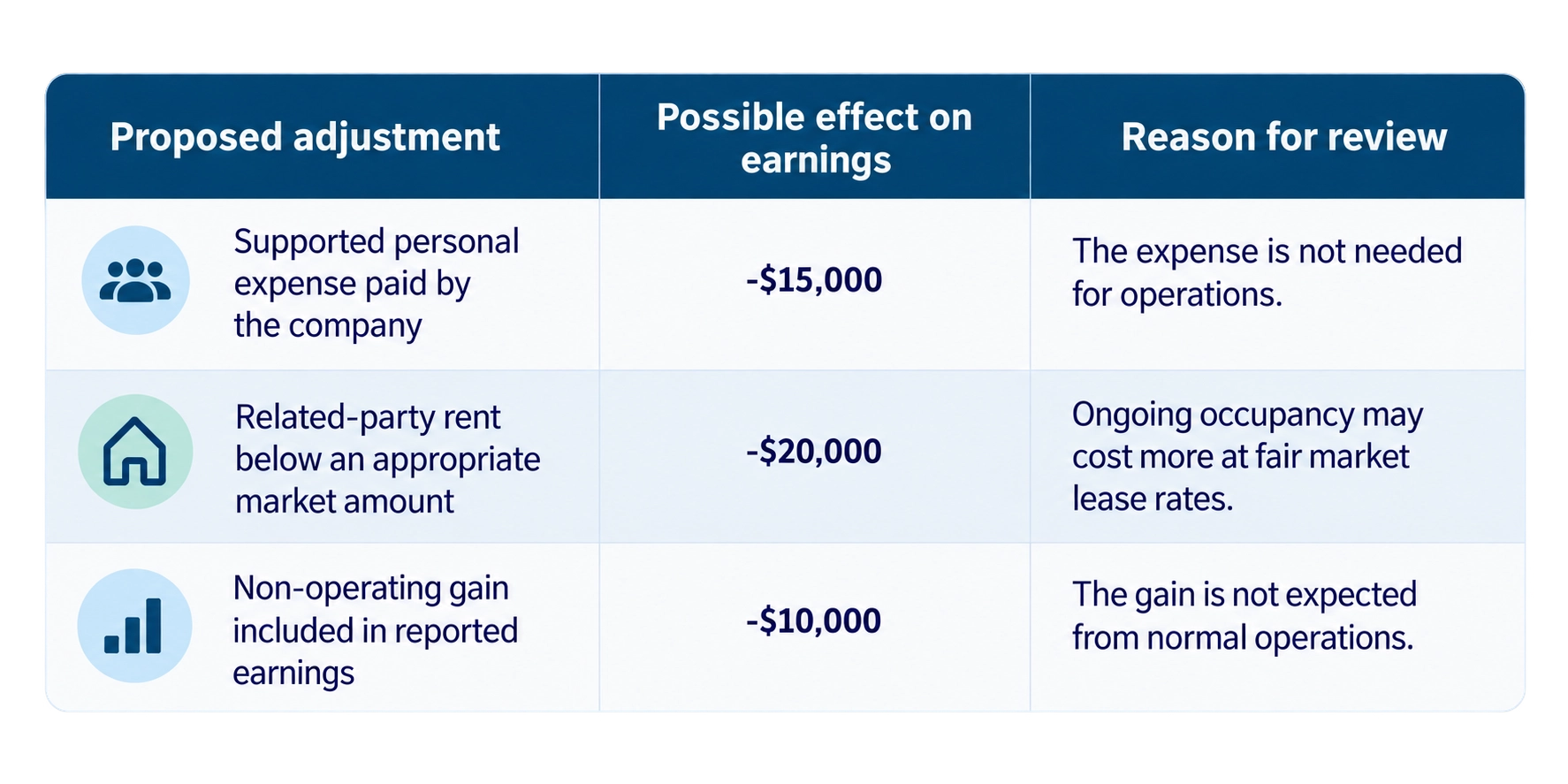
Despite one add-back, normalized EBITDA is lower than reported EBITDA. That is a valid outcome when it better reflects ongoing performance.
The example also shows why a calculator that asks only for “extra expenses to add back” may miss important adjustments that work in the other direction.
Who Identifies and Supports Adjustments?
Owners and management know the transactions behind their financial records. They generally identify the items they want considered and explain why those items may not represent normal operations.
An accountant may help locate a transaction, explain how it was recorded, or reconcile a difference between financial statements and tax returns. Relevant invoices or general ledger detail may support a particular proposal. BizWorth does not collect a complete general ledger as a standard requirement.
The valuation professional evaluates the proposed adjustment, its support, and its treatment within the valuation. An accounting explanation is useful, but the decision to adjust earnings for valuation requires separate judgment.
The strongest proposal identifies the amount, the financial period and account where it appears, what caused it, and why a future owner would experience a different cost or benefit.
How Many Years Should Be Normalized?
There is no universal answer. The appraiser considers the historical periods relevant to understanding the business and its expected performance.
Adjusting one year does not automatically mean the same amount applies to every other year. A personal expense may have occurred in only one period. Related-party rent may need consideration across several periods. Owner duties and compensation may have changed over time.
Recent interim results can also matter. If the business has changed materially since its last completed year, older normalized earnings alone may not capture its current position.
The appraiser should evaluate both the historical pattern and information relevant as of the valuation date. A simple average of adjusted years is not always the best measure of ongoing earnings.
What Is the Difference Between Normalization and a Forecast?
Normalization evaluates whether historical results should be adjusted to better represent ordinary or ongoing operations. A forecast estimates what the company is expected to earn in future periods.
The two may inform each other, but they are not identical.
For example, a company may have incurred an unusual expense in the last completed year. Normalization considers whether that expense should affect a representative historical earnings measure. Separately, if the company plans to open a new location, a forecast may reflect the expected revenue, staffing, rent, and investment associated with that plan.
A valuation professional can consider management projections when appropriate, but the company remains responsible for its assumptions. The appraisal does not automatically validate those assumptions merely because it uses them.
Common Financial Normalization Mistakes
Adding Back Every Owner Expense
An owner may incur expenses that are necessary to generate revenue or operate the business. Each proposed adjustment needs its own review.
Removing All Owner Compensation From EBITDA
The company may need to pay someone to perform the owner’s duties. EBITDA should generally reflect reasonable compensation for required work.
Ignoring Expenses That Are Too Low
Below-market rent, unpaid work, or deferred spending can overstate reported earnings. Normalization may need to reduce them.
Treating Every Unusual Cost as Nonrecurring
An unusually large expense may belong to a category of costs the business will continue to face.
Counting an Item Twice
A transaction adjusted in one category should not be removed again through another calculation.
Assuming Higher Adjusted Earnings Guarantee a Higher Sale Price
Buyers evaluate whether adjustments are supported, whether earnings will continue, and what the transaction includes. An unsupported add-back can make the financial presentation less credible.
Frequently Asked Questions
What are normalized earnings?
Normalized earnings are reported earnings adjusted, where appropriate, to better reflect the business’s expected ongoing economic performance. Adjustments may increase or decrease the reported amount.
Are normalization adjustments the same as tax deductions?
No. Normalization is performed for valuation analysis. It does not, by itself, change a tax return or determine the tax treatment of a transaction.
Can a one-time expense always be added back?
No. The appraiser considers whether the expense, or a similar cost, is likely to recur and whether it was necessary to produce an ongoing benefit.
Who decides whether an add-back is accepted?
Owners and management identify and support proposed items. The valuation professional evaluates whether each adjustment is reasonable and appropriate for the valuation.
Does SDE add back every owner’s salary?
No. SDE generally adds the compensation of one owner-operator to EBITDA. Compensation for other working owners remains in salary expense.
Can adjusted earnings be lower than reported earnings?
Yes. Recognizing underpaid management, below-market rent, deferred costs, or non-operating gains may reduce the earnings used in a valuation.
Bringing It All Together
Financial normalization in a business valuation connects reported financial results to the earnings a company can reasonably be expected to generate. It requires understanding the transactions behind the numbers and evaluating whether each proposed change reflects ongoing operations.
Appropriate adjustments can raise or lower earnings. Owner compensation, related-party rent, personal expenses, unusual events, and missing costs all need consistent treatment and support.
At BizWorth, owners and management identify proposed adjustments and explain material financial changes. Our appraisers evaluate those proposals in the context of the company’s historical results, expected performance, and selected valuation methods. The goal is a supportable earnings measure that helps explain the business’s value.
